Monday, 12 September 2016

Music Video Analysis V: Bryson Tiller - Exchange


Music Video Analysis: Bryson Tiller - Exchange

Directed by Rohan Blair-Mangatt, the music video for 'Exchange' was released in 2016 and follows a fragmented narrative in which the audience are taken back and forth between the past and present relationship featured within the video.

RELATIONSHIP BETWEEN VISUALS AND LYRICS

As previously stated, the music video follows the fragmented narrative of a past relationship and how Tiller and his respective lover wishes to rekindle. It is easy for the audience to establish a clear and solidified relationship between the visuals and lyrics because of how it is based entirely off the song, and bears no relation to a conceptually devised piece. The setting varies throughout the entirety of the video as the audience are taken on a journey from past to present-day and features a myriad of frames that feature intimate low-key lighting to vibrant high-key lighting. In terms of a successful relationship formed through the visuals and lyrics, a wide-angled camera shot features a radio with the overlaying track vocalising, 'everywhere she goes, they're playing my songs', as she looks over to the radio itself. This is significant as it reveals to the audience that she is aware that he is trying to reach her through other forms of communication, i.e. the radio and he wants to let her know that all of the songs are about her. Another example of when the relationship is established between the lyrics and the visuals is when Tiller says "blow dank" which translates to "smoking marijuana", whereby the visual of Tiller lighting up a 'joint' is mirrored with the lyrics. The lyrics themselves speak of heartbreak and redemption as Tiller is desperate to fix his past relationship and often mirror what the visuals are conveying to the audience.


GENRE CHARACTERISTICS

Tiller redefined the R&B music industry when he released 'Exchange' from the album TRAPSOUL in 2016 from the record label RCA. Typically, as a genre, R&B is associated with intimate and subdued visuals, both of which are present within the music video. The majority of the video is filmed with settings that feature low-key, warm lighting, further intensifying the intimacy that the audience would experience as Tiller recalls a past relationship; the stimulus for the entire music video and song itself. There is also an element of performance prevalent within the music video, as a high-angled camera shot captures Tiller lip-synching to the song whilst nostalgically looking out of a window. A further convention of the R&B/hip-hop genre would be that of the expected 'gold chains' donned by the artist; a wide-angled mid shot captures Tiller as he continues to perform to the lyrics of the song whilst also highlighting the two heavy, gold chains around his neck. An interesting feature to note about this music video is that the majority of scenes are shot in slow-motion; this further reinforces the intimate nature of the video and contributes to a typical convention of the R&B genre, whilst pertaining to the cynosure of the song, allowing the audience to appreciate the visuals a lot more.


INTERTEXTUALITY

Intertextuality features through a minimum during the music video for 'Exchange'. The only notable relation that one could infer from another media text would be that the opening of 'Exchange' is similar to that of the opening of 'Heartbeat' by Childish Gambino. This is recognised through the camera following the respective actor walking down a suburban street, adjacent to a fence and seemingly saddened or affected by another person, with a non-diegetic, melancholic beat running in parallel with the visuals (demonstrated through stills taken from both videos [BELOW RIGHT]). As Tiller continues to grace the music industry with his solemn and brooding releases, he gives a hint to the audience of a future music project, 'SHE'S GOT MY SOUL'.  Tiller is now known to go by the alias 'Pen Affleck' and hints that 'SHE'S GOT MY SOUL' may be a music project that is to be released after the platinum album release of 'TRAPSOUL', this is evidenced in the video through a wide-angled/establishing shot of a cinema. Aside from this, there seems to be no other distinct relationship drawn between other media texts and the music video for 'Exchange' but continues to exist on it's own for the remainder of the video.


LOOKING/MODE OF ADDRESS

Throughout the video, Tiller refuses to acknowledge the camera, therefore reinforcing the element of disconnect between artist and audience. Because of the overarching theme of the song, being it a homage to heartbreak and redemption, this would be expected as Tiller remains no way inclined to publicise the extent of his feelings as the non-diegetic, overlaid sound continues with it's melancholic beat accompanying the visuals and further pushing the story onwards as to establish a clear, but fragmented narrative. However, there is one direct address to the audience near the end of the video, where a close-up shot captures Tiller in a state of agitation, accompanied by harsh red, low-key lighting. There is an element of Colour Psychology prevalent here that establishes a foreshadowing of some sorts and as an interpretation, the general population would associate the colour red with either anger, love and/or danger. As the narrative ensues, the audience are aware that he drives "back and forth from Louisville to Lexington" to meet his ex lover, this highlights an element of danger, for fear that the girl won't reciprocate his feelings and he will have his heartbroken again; anger, so that the girl and him get involved in an argument or, finally, love; wherein the pair reconnect at the end of the video and rekindle the relationship. This close-up camera shot highlights to the audience that Tiller is indeed trying to connect with the audience as compared to at the beginning of the video where it could be inferred that he was reluctant in opening up about his feelings, but is now in a position to reconnect and accept the extent of what he feels for his ex lover.


LINEAR OR CLOSED NARRATIVE & NARRATIVE AND/OR CONCEPT?

As previously stated, the narrative is fragmented but is closed, as it seems to be that Tiller and his ex lover come to a state of reconciliation by the end of the video. The way in which it is fragmented is that the quick-cut and slow-cut camera shots jump back and forth between the past and the present, although bearing no significant detail as to how the audience would differentiate the two separate narratives much like in the music video for 'Everybody Talks'. In terms of complexity, the narrative exhibits no ambiguity or hidden subliminal message, therefore reinforces the idea that the music video was driven solely by the message of the song; which was to rekindle an old relationship.

STAR TREATMENT

Tiller operates as a sole artist under the record label RCA. As a new and up-coming artist within the music industry, audiences start to establish links between the artist and their music, such as through artist iconography. Albeit, considering that Tiller is new to the music world, not a lot of theory could be applied that would detail audience recognition as he is steadily building his fan-base with the release of the platinum album 'TRAPSOUL'. Although, the release of the album gained Tiller immense notoriety from the public with the single 'Don't' being released in early 2015 and started to solidify the franchise behind 'TRAPSOUL'. Throughout the video, Tiller is consistently seen by the audience as the narrative unfolds, with a variety of differing camera shots that establish his status and dominance throughout the video, but very rarely are there close-up camera shots of the artist.


MIS-EN-SCENE

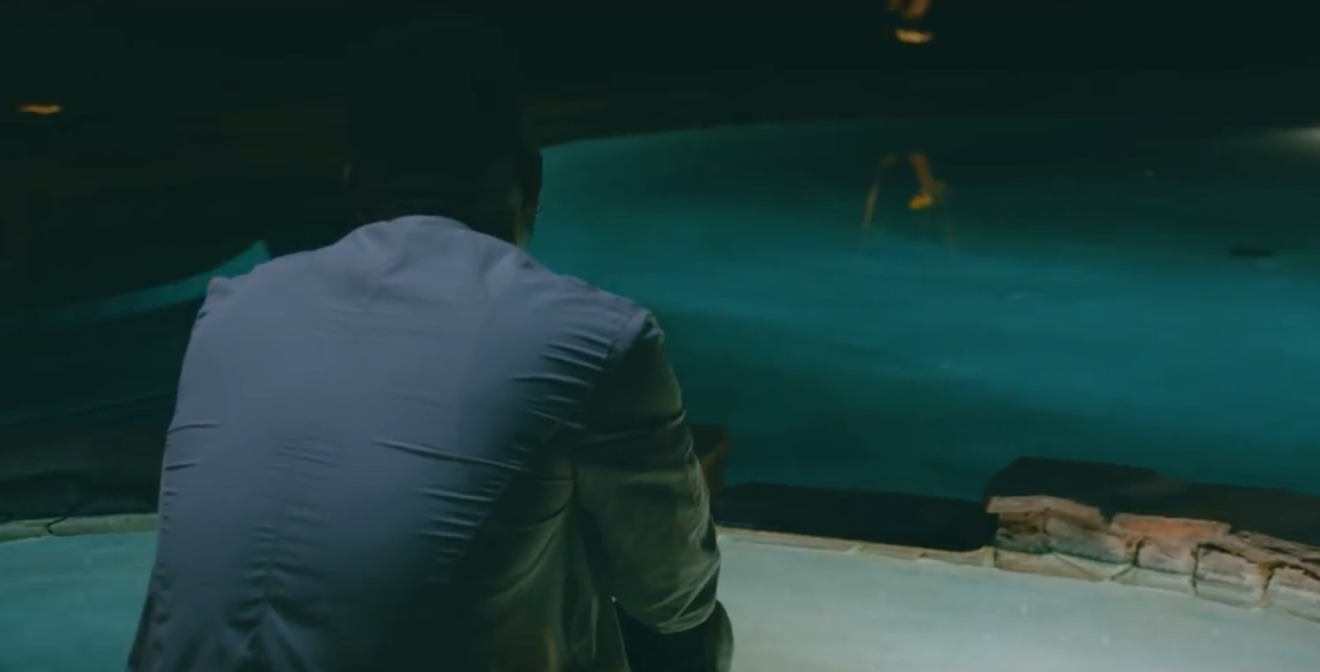
The video features a fragmented narrative, as the aforementioned point states, but however lacks in the diversity in setting. Because of this fragmented narrative, the audience are taken on a journey of a recollection of memories that are seen through wide-angled, high-angled panning shots of the pool and contrasted with a quick-cut edited shots of the past that are shown to the audience through low-key lighting and a mid-shot of Tiller. The significant contrast in camera angle and lighting are important as it highlights Tillers feelings at that time and ensures that the audience can distinguish a clear narrative and difference between the past and the present. Vibrant high-key lighting accompanied by a high-angled panning camera shot of Tiller enforces the happier times that he had during the relationship, although, a typical high-angled camera shot would disempower the artist (as shown through the still on the top right) and empower the audience; subverting the typical convention of the camera angle. However, this choice in camera angle could suggest that the relationship was known to the public, as the enforcement of power to the audience is suggested by us looking down on Tiller and his lover. Perhaps alluding to the idea that because the relationship went too public, it was inevitably what tore them apart. As the narrative continues, the sexualisation of the female ex lover is apparent to the audience and appeals to Laura Mulvey's ideology of 'The Male Gaze', in which female actors or performers are portrayed in such an overtly sexual or provocative way, as to satisfy the male population. An intimate, subtle high-angled camera angle portrays Tillers lover in a sexual light as it is accompanied by amorous low-key lighting, scantily dressed in frilly, white lingerie, while she seductively rubs her hands over the tops of her thighs. The colour white, in most senses, is associated with purity and 'virgin-like' attributes, however, the depiction of the woman and her 'purity' in this video is heavily subverted as she is objectified in order to satisfy the male demographic.


https://www.youtube.com/watch?v=aj9coPGuFkM

Sunday, 11 September 2016

Andrew Goodwin Music Video Theory


Andrew Goodwin Music Video Theory

There are many theories in Media Studies, all of which culminate to form certain ideologies about different media texts and forms, rarely are there ever theories that can be applied to the artistry of music videos, however. 

But, through the theory coined by Andrew Goodwin, studying and analysing the forms of a range of music videos has never been so easy, thanks to a checklist of features that amalgamate to create a successful music video.

The theory includes a checklist of seven key points that should work in complete synergy in order to form a music video. This checklist encompasses the series of codes and conventions that music videos should have in common, whilst reiterating the fundamental basis of all music videos, which is to have a strong, constructed link between the visuals, the song and the artist or band

Key features of Goodwin's Theory:
  • Typically, all music videos have unequivocal genre characteristics that would pertain to the specific genre of music being relayed to audiences.
  • There is almost always a relationship between the visuals of the video and the lyrics performed by the artists. 
  • Demands of the Record Label (i.e. Warner Bros.) will be evident within the video and represented by the artist.
  • Intertextual references are common, too.
  • The 'Notion of Looking' (such as the objectification of women and men - links to other theories such as 'The Male Gaze' theorised by Laura Mulvey) with features of 'Voyeurism', such as direct gaze, screen and mirrors and potential insight into the life of the artist
  • Artist Iconography/Star Image.
  • There is a strong relationship between the music and the lyrics.
Below, there are examples that further deepen the understanding of these key features of Goodwin's Theory that feature across a range of music videos and genres.


Notions of Looking/Voyeurism/Objectification

Taken from Childish Gambino's music video for 'Heartbeat'. (RIGHT)

Here we see Gambino (Donald Glover) directly addressing the camera through a cars rear view mirror. The song is a tribute to Gambino's 'True Love' or 'The One' and
not being able to be together. This direct address heightens the intense relationship between artist and audience as Gambino continues on to signify his heartbreak of not being together even though the pair are still in love, through the lyrics.


(LEFT) Taken from Shakira's music video of 'Can't Remember to Forget You'. 

Here we can see the blatant objectification of Rihanna as she is captured in a provocative pose in an effort to satisfy the male demographic; this is closely linked to Laura Mulvey's theory of 'The Male Gaze'. 


(LEFT) Taken from The 1975's music video for 'Love Me'.

This still shows Matt Healy looking directly at the camera without the use of mirrors or screens. The element of voyeurism is present as we are watching Healy perform the song through an extreme close-up camera shot. 

(BELOW) Taken from Carly Rae Jepsen's music video for 'Call Me Maybe'.

This is an example of male objectification in order to satisfy the female demographic, more often than not, males who are objectified are usually portrayed without a shirt revealing the upper torso, in comparison to the objectification of women who are seen scantily clad, filmed with high-angled camera shots that further the objectification.

Genre Characteristics

Examples that pertain to the genre of rock and what would typically feature in a music video for that specific genre, would be that of the entire band performing, usually filmed through a wide angled, level shot so that it sustains the equality of the entire band instead of focusing on a sole member. 

Taken from the Red Hot Chili Peppers music video for 'Californication'. 

Every band member is present here which enables the audience to identify more with the music as they can see the full involvement of the band. The wide angled shot represents the band and it's unity, straying away from any misconstrued ideas about status as they are captured on a levelled shot. 


Taken from The 1975's music video for 'UGH!'.

Although the faces of the band members cannot be seen by the audience, they are still aware that the band performs together, solidifying the sense of unity within the band itself. 


Intertextual References

The concept of intertextuality makes the audience feel superior if they know elements of other media forms have been included in others. Intertextual references are always exciting to find and increases audience engagement with the media form, whether that is through a film or music video. 

Thirty Seconds To Mars released a music video for 'The Kill (Bury Me)' in 2010 that was heavily influenced by Stanley Kubrick's, 'The Shining'. The intertextual references are outstanding and somewhat follows a similar narrative to that of the actual film. 

Here are stills taken from the music video and the film that depict an intimate moment between two 'unorthodox' lovers.


Another scene of comparison is when Nicholson is alone in the main hall and starts to throw a tennis ball up against the wall, this is also shown in the music video where Jared Leto also throws a ball at a wall. Comparing the camera angles, the music video still shows a wide-angled shot that captures the momentary interlude where Leto continues to lash out at a wall with a tennis ball, there is an absence of diegetic sound.

The camera angle that captures Nicholson throwing the ball at the wall is also a wide-angled shot, but masks his face as it is filmed from behind. A similarity that can be drawn from these two stills is the limited lighting, which is inferred as low-key. The low-key lighting reflects the sombre mood of both the film and the music video as the narrative unfolds.
Although in terms of colour palette the two media texts differ, the music video follows the majority of the narrative as directed by Kubrick in the film. Compared to the film, the music video is bleak and features a desolate hotel, whereas the film depicts a wintery setting with warm hues and ornate walls.

Music Video Analysis: Jamiroquai - Virtual Insanity


Music Video Analysis: Jamiroquai - Virtual Insanity

Jamiroquai's music video for 'Virtual Insanity' is most notably a conceptual piece. Released in September 1996, Jonathan Glazer combined oddities that were then amalgamated into an aesthetically bizarre and unorthodox, conceptual music video for the hit song. The video is the epitome of intrigue as the audience are shifted back and forth between blank settings with only one object being the focal point, such as the couch or the cockroaches. An interesting feature of the music video is the use of special effects which gained notoriety from critics as a moving floor was typically seen as unconventional during the time period of which the video was released. 


RELATIONSHIP BETWEEN VISUALS AND LYRICS

A baffling yet interesting music video creates great intrigue for the audience as they try and determine a relationship between the visuals and lyrics, of which, there is one. The setting of the music video is agreeably bleak, and is evidently filmed in an enclosed room with featureless, white walls, a moving grey floor but is accompanied by intense, luminous high-key lighting. Lyrics often speak of impending technological advancements and how the future could be drastically altered if we don't heed to these advancing concepts; which in one sense, would marry with the visuals as a typical convention of the "concept of technology" would be the sleek, featureless, white coloured surfaces of objects or rooms, as seen in the music video. An example of the relationship between visuals and lyrics is where the song starts with "who can tell what magic spells", and it seems as if Jay Kay is as if by "magic" coercing the chair over to him, but it is in fact the moving floor. The bleakness of the video could be of significance as it detracts from any obvious message that could have been easily relayed to audience through use of colour or objects that are indicative of any subliminal message, but is perhaps symbolic of the emptiness that humanity could face with advancing technology.

GENRE CHARACTERISTICS

As a band, Jamiroquai are known for their outlandish 'acid jazz/funk' genre, which is typically a combination of dance, disco, jazz and soul music. Albeit, there are no significant genre characteristics displayed throughout the videos entirety as I believe that the band wanted to encapsulate the harsh reality of technological reign if humanity lets it go too far. The absence of colourful settings, such as multicoloured lighting, commonly associated with a club setting and the genre of 'disco' coalesces together with the entire subliminal message of the video that is indeed reinforced through the bleak setting. However, a convention of the 'disco' genre that seems to have been retained is that of the precise and 'funky' dancing by lead singer Jay Kay, of which wide-angled mid-shots capture this. A constant that remains throughout the video is the intense, luminous high-key lighting that could be associated with the genre of the music, especially the genre of funk, although, not in its entirety. Other than the minimal genre convention mentioned, there are no significant genre characteristics present within the video that audiences can identify, other than the overlaying track and the dancing. The setting, of which is of ultimate significance in order to relay the message of the song is stark, and therefore offers no deeper meaning to the audience

INTERTEXTUALITY

There was no notable intertextual links that I could infer from this music video, as it seems to be based purely on the message of the actual song lyrics, therefore created entirely for that purpose and is absent of any other relation to other media forms. 

PERFORMANCE, NARRATIVE AND/OR CONCEPT?

At first, it would seem that the music video offers nothing interesting to the audience, aside from the lead singers 'funky' dancing. But considering that this video is heavily conceptualised, it offers the audience with an underlying message through it's progressive, cyclical narrative. The video takes the audience through the world of 'Virtual Insanity' through slick but fast camera angles, in which the camera suddenly jolts up to the ceiling, then brings the audience back down into the room but with the seating arrangement changed. As well as this room change, it also takes the audience into an entirely different room where Jay Kay is seen side by side with six men who remain in a statuesque state, clinging to the wall.  Performing throughout the song is in the hands of the lead singer as he lip-synchs to the song, but it fails to capture the rest of the band, therefore is limited in the "all inclusive" performance aspect of the entire band. 

LINEAR OR CLOSED NARRATIVE?

It could be inferred that the music video follows a cyclical narrative in the sense that it brings the audience through to different settings, but ultimately ends up with the original setting, therefore completing the cyclical, structured narrative of the video. There is only evidence of a singular, linear narrative throughout the music video, making it less complex in its execution, but as the purpose of the video is to "educate humanity", it would be appropriate that the music video was devoid of a complex narrative, as it conveys the message quickly and effectively to the audience.

LOOKING/MODE OF ADDRESS

Throughout the video, there is a variety of extreme close-up camera shots that capture Jay Kay's lip-synching and facial expressions, which would have an effect on how the audience receive the song. The close up-shots show how involved Jay Kay is with the music and how there is no evident disconnect between performer and audience.

STAR TREATMENT

The video only focuses on lead singer, Jay Kay, through various wide-angled camera shots and notably excludes the remaining band members. This was done with intention, for example, in terms of star recognition and based on Richard Dyer's 'Star Theory', Jay Kay would have been utilised as a pivotal tool in order for the audience to recognise and become increasingly influenced by what he is trying to convey throughout the song. Jay Kay is probably the most well-known band member from Jamiroquai, therefore the intentions of the record label would be that considering that he would already have a wider established fan-base than the other band members, he would have been used as an influential person to convey the subliminal message. A technical feature that backs this claim would be that there is no use of high-angled camera shots when the audience is shown Jay Kay, thus eliminating the idea that he has been empowered or disempowered, but instead is shown to have equal status throughout the video. If he was empowered with low-angled camera shots, the audience wouldn't feel compelled to listen to the message behind the song, likewise if he was disempowered with multiple high-angled camera shots, the audience would be dismissive. 

MIS-EN-SCENE

Through it's entirety, the video pays homage to the idea that as the future progresses, humanity could become enslaved by the rapid advancements of technology if we don't take initiative and solve the problem first. A special effect that could be inferred as having a deeper meaning is that of the moving floor laden with a variety of couches, but yet, still remains astonishingly minimal. It can be inferred that this feature is used to illustrate the idea that as a race, we are constantly moving but ultimately, we aren't going anywhere if we let technology hinder our ability to progress and evolve as a society. Jay Kay is seen to be walking and dancing on this moving floor, but still remains in the same position, which further reinforces this idea. Colour Psychology is introduced to the audience yet again through the dismal, two-toned, almost monochromatic colour palette of the walls, floor and surrounding objects. The cold colours invokes no feeling at all, aesthetically it is far from pleasing and ultimately conveys the emptiness that would ensue if we were to become controlled by technology. There are two symbolic features within this music video; the cockroaches and the crow, both contributing to a contradicting message. Cockroaches are typically impervious to outstanding forces and can withstand anything, but could be indicative of an underlying message that as humanities impending decline continues, these will be the only remaining creatures that withstood humanities neglect of emotions and it's society due to the infatuation with technology. Likewise, the symbolism behind the crow is that of it is typically associated with death or decay, much to mirror the subliminal message of the video. However, through it's positive connotations, the crow is often admired as a messenger, commonly associated with delivering omens. Therefore, representing hope and the potential breakthrough in human neglect as we stand together to change humanity for the better. The crow is seen through low-angled, wide-angled, tracking shots, which in turn creates the illusion of an overseer, and slightly disempowers the audience. There is no evidence of diegetic sound, perhaps alluding to the idea that audiences would be distracted from the message of the video, and is instead compelled to listen to the song as it resonates its message.

Furthermore, it can be concluded that such minimal features (i.e. the cockroaches/crow) contribute to the reinforcement of the overarching message of the music video, as shown through a variety of shots, absence of vibrant colours and lack of aesthetics.


https://www.youtube.com/watch?v=4JkIs37a2JE

Wednesday, 31 August 2016

Music Video Analysis: Neon Trees - Everybody Talks


Music Video Analysis - Neon Trees: Everybody Talks

The music video for 'Everybody Talks' by Neon Trees is that of an extreme concept piece, featuring a 1950's setting and a video within a video, the piece is visually appealing whilst maintaining its complexity and is certainly not one of the more conventional 'pop music' videos. It opens with what seems like an advertisement for a film, played in parallel with what can only be imagined as a paradoxical feature of non-diegetic sound as well as diegetic sound, as we, the audience can hear it at first, but then it slowly transforms into a segment that the people in the video can hear as well. Thus, adding to the videos already complex nature. 

RELATIONSHIP BETWEEN VISUALS AND LYRICS

An interesting music video makes for an interesting relationship between the visuals and the lyrics, and 'Everybody Talks' is no exception. The relationship between the two appear to be fragmented at first, as the audience is shifted back and forth between "reality" and the music video within the music video. Wide angled mid-shots from either two settings feature the lead singer, Tyler, lip synching to the lyrics, a notable convention of music videos. However, there were also moments where him and the rest of the Neon Trees were acting throughout with the music continuing on in the background. As the actual music video progresses, we see less and less of the band singing within its "reality", and more through the dominating video. A momentary interlude was featured allowing the music video featured within the actual video to progress its narrative; all music ceased and it was reliant on the acting to further push the narrative forward. The directors cleverly introduced a way for audiences to distinguish between the "reality" and the music video by layering a worn out camera filter, with burns and scratch marks, which was heavily reminiscent of the time period during the 1950's. 

GENRE CHARACTERISTICS

From the outset, the genre of this music video was seemingly a little difficult to identify as there were hardly any codes and conventions that reinforced the pop/rock genre characteristics; but as the narrative progresses, the audience can identify subtle genre codes such as the leather jackets that the characters were wearing, typically associated with the rock genre. This was also contrasted with that of the pop genre element of the video; Tyler and the rest of the band donned extravagant clothing such as a cheetah print coat and a gold sequinned shirt. Another reinforcement of the pop genre specifically, is that there is a lot of choral inclusion within the music video. The band have displayed choreographed dance scenes, lip-synching scenes and so forth; all identified and conveyed to the audience through wide angled mid-shots, panning shots and slight overhead shots. There was a myriad of different lighting throughout this music video, most of which were evidenced by quick-cut camera shots that allowed clips of low-key lighting to transition to high-key lighting very fast. A key element of a pop music video is the high-key lighting, which albeit was prominent throughout the video, but one could also identify that considering that there was a clash of genre (i.e. pop and rock), the high-key lighting was representative of the pop elements of the video, whilst the low-key lighting was reminiscent of the rock genre.


INTERTEXUALITY

Intertextuality throughout this music video was a task to say the least, but eventually, there was something that linked to one of the most famous films of all time: Grease. Although this intertextuality wasn't a constant throughout the video, it was however featured in some of the panning shots, mid-shots and close up camera angles. Each shot identifies cars linked to the 1950's, specifically '57 Chevy's; cars of which were featured heavily within the 1978 film. Grease is a musical film that focuses on the trials and tribulations that the rival gangs, 'The T-Birds' and 'The Pink Ladies' encountered, whilst also providing the audience with an amalgamation of comedic and romantic aspects. The music video for 'Everybody Talks' actually shows what seem to be two gangs situated in their respective cars whilst watching the film at the drive-in theatre. Panning shots reveal a car filled with boys with leather jackets and greased back hair, while the camera focuses on a mid-range shot of the girls in the opposite car, thus alluding to the idea that these two "gangs" were inspired by 'The T-Birds' and 'The Pink Ladies'. Another feature that contributes to the intertextuality of Grease is that every person at the diner breaks out into song and dance, something of which was extremely prevalent within the musical film. 


PERFORMANCE, NARRATIVE AND/OR CONCEPT?

As the aforementioned point briefly explains, this music video is remarkably complex in terms of it's execution. The video exhibits most features of a performance piece, follows a narrative of "boy in love with girl, girl plays hard to get" whilst also remaining solidly in its complexity as a conceptually driven piece. Although, having said this, the music video doesn't really mirror anything to do with the lyrics of the song, therefore reinforcing the stronger sense of a conceptual piece as nothing in the lyrics suggests that the video should be filmed a 1950's drive-through diner/theatre, or have anything to do with "Zombie Bikers from Hell". All in all, the video is heavily influenced by a conceptual idea whilst also continuing a thread of whimsical performance by each and every band member, as well as the other characters featured in the video.

LINEAR OR CLOSED NARRATIVE? 

There is a strong sense of narrative within this music video as briefly mentioned above. However, what could be considered unusual within this music video, is the directors choice to have the audience jump between "reality" and the short film that features. Because of this, it is easy to distinguish that the narrative, yet again, is of paradoxical nature. The narrative is simple, "boy falls in love, girl is difficult and unwavering in her flirtatious attitudes towards him". The reason why it is paradoxical is because it would seem to contradict a strict linear narrative, but it in fact does follow a singular narrative, the audience is just involved with a secondary narrative running alongside the main one, which makes the music video that much more complex. 

LOOKING/MODE OF ADDRESS

Throughout the video, there are a whole range of close up shots that focus predominantly on the lead singer, Tyler. Through these different camera shots, a host of them are where he directly addresses the camera, leading to believe that there is no disconnect between him and the audience, but instead reinforces a strong relationship between him and the music, in the sense that he uses eye contact to sway audiences into truly being involved with the song. As for the female protagonist, there are yet again, a myriad of close up camera shots, yet she rarely addresses the camera as most of the time she hides behind sunglasses. This could allude to her character being of ambiguous nature as she conceals most of her face throughout the entirety of the video, also adding to her mysterious yet flirtatious appeal to the lead singer. 

STAR TREATMENT

The entire video centralises itself around the entire band, with everyone being in equal status to one another. Aside from the wide angled mid-shots that successfully capture the whole band, these shots are accompanied by different levels of lighting, ranging from low-key to high-key. The idea of extreme close up shots of each member reinforce the emotion of the band; happy and joyous. This is again, mainly accompanied by high-key lighting to further reinforce the "happy-go-lucky"allure of this up-beat pop/rock song.

MIS-EN-SCENE

The overarching influence of this music video was a concept heavily influenced by the 1950's; a stimulus that could be considered unusual in this highly modernised 21st Century. Released in 2012, 'Everybody Talks' pays homage to a quirky relationship, with the mis-en-scene used to later reflect this. Camera angles throughout this entire video didn't seem to have much variation, with them only remaining on a levelled position, there was no room for empowerment or disempowerment of any of the band or other characters. A notable feature throughout is the vibrancy of the colours accompanied by the high-key lighting. The neon signs of the diner give the audience crisp visuals of the surrounding setting whilst perhaps contributing to a deeper, subliminal message of a fresh new relationship about to begin. There is also a secondary message throughout the video, perhaps a little more philosophical than concerning a relationship.  It is that "not everything is as it seems", this is reinforced through the minor special effects utilised within the video of when the female protagonist lures her victims into a secluded area and then continues to scare them. 

https://www.youtube.com/watch?v=X5G9tIe84lE


Seven Nation Army - The White Stripes: REMAKE


Seven Nation Army - The White Stripes: REMAKE

THE INITIAL PROCESS & SET UP

As a cohort, we took advantage of the Creative Arts Evening in order to recreate the music video for 'Seven Nation Army' performed by The White Stripes. We recruited musical talent from a Year 8 band and asked them to perform the song in front of a set up that we constructed ourselves, using a sheet of green fabric to replicate a green screen, multiple lights and microphones

Initially, we asked the band to perform twice; once to record the audio, and second to record the visuals that were accompanied by the audio that we had just recorded. Considering that we had recorded the audio, we were then able to ask the band to perform individual shots lip-syncing to the song. To effectively re-create the video, we used a myriad of shots ranging from profile shots, mid-shots and wide angled shots, much to simulate the shots featured in the actual music video. Whilst changing the angle of the shots, we also had to consider the lighting position as to draw exact influence from the video; for example, for a profile shot of the lead vocalist, we situated the light in front of the performer so that the features on his face would be illuminated, casting shadows behind him. The lighting featured for the profile shot was low-key lighting, whereas the rest of the band were filmed predominantly in high-key lighting also to capture all expressions of the band members. In order to capture the right shot, there was a lot of messing around in terms of positioning the camera in order to fit each band member in frame; this process was imperative as it would make pre-production editing a lot easier.

PRACTICE & POST PRODUCTION EDITING

Once we had all of the footage that we needed in order to successfully and confidently re-create the music video for 'Seven Nation Army', we each took to 'Final Cut' (an editing software) and aptly prepared short clips in the style of the original music video. In order to re-create the video perfectly, we each went through a step-by-step process outlining the steps of editing ranging from 'keying', 'masking' to colour correction and alteration. The first steps were to overlay the video clip with a 'keyer'; a tool that selects and erases a large area of colour, which in this case, was the green screen. This process was important as it was used to isolate the band members, allowing us to transfer any image to the back of the video and in keeping with the theme of the original 'Seven Nation Army' video, we transferred different colour '.png' triangles onto the background. The reason why the triangle image had to be a '.png' file was because a file with this format, is saved with a transparent background, making post-production editing easier. Once we had 'keyed' the video clip, it was important to undertake a 'view' check in order to make sure that once the 'keyer mask' was applied, the edges surrounding the band member was as slick as it could be, and if not, we could alter it to make the clip sharper.


The second step, which in my opinion was the most important, was to adhere to the colour correcting by adding a 'Threshold' mask over the video clips. This mask allowed me to drastically change the colour in order to suit the original video colouration. In this editing step, there were two colours that we had to take into consideration, the 'light colour' and the 'dark colour', both of which essentially acted as the 'highlights' and 'lowlights/shadows'. The original colouration of the video exhibited a cyan hue, something that was easy to achieve using Final Cut. With this in mind, it was important to select a cyan colour for the highlights whilst also selecting a darker blue colour for the lowlights/shadows. With the correct colouration adhered to, I then went into change the intensity, threshold and smoothness of the mask; creating a sleeker appearance and suiting nicely to the original video.

Once the 'Threshold' mask had been applied, it was now time to move onto the 'colour mask [ing]' process. This process allowed me to target any feature that I wanted to change, keep or isolate its colour; in this case, it was the tie. Adding a colour mask to the tie allowed me to keep the original red colour, this creative technique of stark colour contrast (i.e. the cyan colouring with a bold red) was featured within the original White Stripes music video.

FINAL THOUGHTS AND IMPROVEMENTS

If I could suggest a minor, personal improvement, it would be to explore alternative ways in which I could really capture the grittiness of the original music video. Some of the clips were a little too soft with the cyan hue smoothing out the musicians far too much, so for future improvement, it would be to experiment with the harshness of the Threshold mask in order to capture the refined lines of the face, exaggerating them to fulfil a dramatic effect.

A further note, if I had the opportunity to do anything differently, I would play around with the lighting that we used to illuminate the faces of each musician, particularly the lead singer. I felt as if the lighting that we used for the singer was too bright, therefore hindering my ability to capture harsh grittiness/dark lines during the post-editing process. With this in mind, I would have had a light that was illuminated from the bottom, therefore exaggerating his facial features and casting harsh shadows, whilst also utilising a singular side light (situated either left or right).

Overall, my clips came out exactly the way that I had envisioned them. They were precise, re-worked when I didn't feel like it was good enough, and a lot of effort was put into ensuring that the clips mirrored the way that the directors, Alex and Martin, had created such a complex but visually stunning concept music video.

Monday, 11 July 2016

Music Video Analysis: The 1975 - Somebody Else


Music Video Analysis - The 1975: Somebody Else


Directed by Tim Mattia, the 'Somebody Else' music video opens with a monochromatic prelude that is seemingly a continuation from their previous newly released music video for 'A Change of Heart'. A notable creative technique as displayed at the start of the video is the introspective and musing two minute overture that is devoid of the track itself, but however features an eerie non-diegetic laughter-track in which evokes feelings of mockery and humiliation. The central theme of the music video focuses deeply on heartbreak and the self-destruction one goes through when going through a break-up, the audience follows the lead singer, Matt Healy, on this road of self-destruction as he looks for solace through alcohol and a one-night stand. 


RELATIONSHIP BETWEEN VISUALS AND LYRICS

The relationship between the visuals and the lyrics seem to be fragmented, as Healy is seen to be lip-syncing some of the words to the song, but is however involved with pushing the narrative forward as well. Upon further glance, the music video is evidently a conceptual piece, although holds true to some conventions of a typical performance piece i.e. such as the lip-synching. Inference can be made through the symbolic nature of the video as the events that unfold throughout the media text follow a narrative that can be distinguishable with the effect of heartbreak, such as the reliance on alcohol to forget and outwardly, boisterous behaviour as evidenced through a quick, wide angled mid-shot of Healy throwing a skateboard.


GENRE CHARACTERISTICS

The genre of the music video is established through various camera shots and even the clothing that the singer, and other characters in the video are wearing. Typically, leather clothing would be associated with the rock genre, however, in this video, a multitude of characters are seen donning leather attire adding to the 'grunge' appeal of the video. As a band, The 1975 are known for their 'Indie Rock' and 'Alternative Rock' music; with the genre conventions being upheld and reinforced throughout the video with quick-cut shots that intensifies the downward spiral the lead singer faces whilst experiencing heartbreak, sombre, low-key lighting and a host of wide angled mid shots that clearly identifies the lead singer; a repeated convention that pertains to the genre of Rock and/or Indie music videos. Another poignant convention worthy of note is the irrefutable repeated motif of alcohol; which happens to be another convention that is typically associated with the rock genre. A wide angled shot captures the intimate moment between barkeeper and Healy as his dependency on alcohol increases throughout the video, accompanied by warm, low-key lighting.


INTERTEXTUALITY

Intertextuality throughout this music video can be observed through the reference to some of their other songs and features that hold symbolic value to the actual band. A blatant attempt at intertextuality is the neon sign that reads 'GIRLS'; which is a song performed and released by the band in 2013, in which the lyrics suggest that 'girls are there to inevitably break your heart, but don't realise that they do, as they just use their looks to get what they want'. This very poignant intertextual reference alludes to the idea that the song, 'Somebody Else' is a run-off from 'Girls', as the cynosure for this song revolves around a broken heart. With the aforementioned point about the monochromatic interlude, this mini-featurette holds significant intertextual value as it is a continuation from the previously released music video for 'A Change of Heart'; wherein Healy dons clown attire, and in this vignette, he removes all make-up which adds to the sombre effect of the music video.

PERFORMANCE, NARRATIVE AND/OR CONCEPT? 

This music video is heavily driven by narrative, more so than a performance concept; as it focuses centrally on the lyrics and how it could then be spun into a short film that revolves around adding visual creativity to the lyrics in order to make them more appealing to the audience.


LINEAR OR CLOSED NARRATIVE?

What is interesting and potentially unconventional about this music video, is that it is a continued narrative from a previous music video by the band. Because of this, it is evident that it follows a strict linear narrative and almost indefinitely stays in line with the lyrics being represented. However, an identifiable creative technique of the music video is that it continues on a linear narrative path, but then jumps back to certain scenes in which aspects of the scenes are different, this is evidenced through the screenshots of the video below. This technique ultimately allows the audience to identify a creative outlet through juxtaposing reality and dream, centred around Levi Strauss' Binary Opposites Theory. Based on Todorov's Theory of equilibrium and disequilibrium, this music video exhibits no equilibrium whatsoever, and instead continues on with a series of unfortunate events that unfold as a result of heartbreak.

LOOKING/MODE OF ADDRESS

There is a myriad of close up shots of Healy, yet there is no time in which he directly addresses the camera; thus alluding to the idea of a disconnect between audience and band member. This distance is established as the mode of address is significantly minimal to none, therefore reinforcing the idea of which Healy experiences detachment from the audience, perhaps drawing a parallel to the heartbreak he is currently feeling, evidenced throughout the video.


STAR TREATMENT


The music video only portrays one band member throughout it's entirety; the lead singer. This may be poignant as his is distinguished through varying camera shots such as extreme close-up shots in which his emotion is captured and relayed through to the audience and centres around his own heartbreak. Lighting-wise, low-key lighting tends to be evidenced in all frames surrounding Healy, as to to continue the melancholic theme throughout the video.

MIS-EN-SCENE

Tim Mattia opted for a creative outlet in which to convey the subliminal message of the song, through varying degrees of juxtaposition, repeated motifs and intertextual messages that are parallel to the bands former songs. The music video in itself follows the path of self-destruction someone faces when dealing with heartbreak, so as to provide the appropriate conventions associated with the topic, Mattia uses a multitude of scenes wherein low-key lighting reflects and highlights the melancholic emotions experienced by Healy. The screenshot above captures a frame in which Healy is isolated and alone in his car, with post-production editing providing a cool, blue hue in an effort to eliminate any enigma surrounding Healy's feelings (i.e. a feeling lonesome, wallowing). Colour Psychology is used effectively throughout this video, leaving the audience with the ability to blatantly infer the underlying message conveyed through different scenes through the use of colours. For example, the scenes in which the strip-club is portrayed are always surrounded by purple and pink hues, indicating passion and sensuality; two common associations with an environment such as that. Turning attention to the clothing, Healy always dons black, and sometimes leather clothing, in which to create the enigma of mystery surrounding his heartbreak, as the 'heartbreaker' per say, is left entirely ambiguous throughout the music video. Disempowerment and empowerment feature heavily throughout the video, as exhibited through low-angled and high-angled camera shots. 

https://www.youtube.com/watch?v=Bimd2nZirT4